Challenge
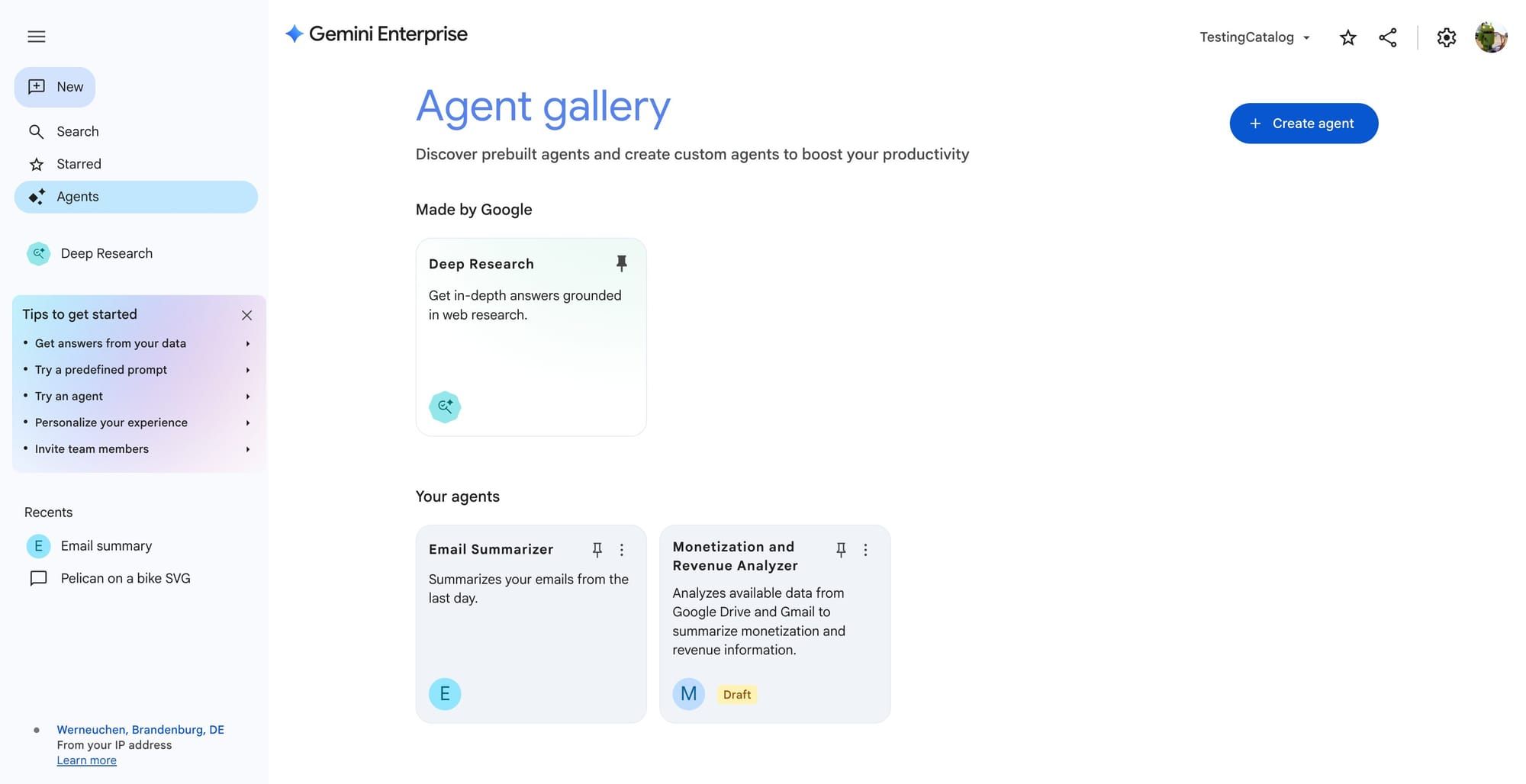
A form-based MVP couldn't serve real enterprise users - HR admins, IT managers, and business ops leads who needed to build agents without understanding the underlying ADK architecture.
Strategy
Designed two paths to the same agent: a conversational builder powered by Gemini, and a visual flow editor - letting business users and technical users work in the same product without compromise.
Results
Shipped GA in October 2025 on schedule - announced at two major Google events (Cloud Next + Google I/O), with 6 complete CUJs and 15+ validated design iterations.
Challenge
The form-based ceiling
When my team started on the project, the proposed MVP was a form-based interface. User fills in Agent name, Description and instructions. It would work for developers who understood the underlying ADK architecture. For the real target audience - HR admins, IT managers, and business operations leads - it was a dead end.
The brief: evolve the builder beyond its initial form to serve enterprise business needs. The real challenge was to include complexities like tools, knowledge sources, sub-agents, logic flows, and deterministic steps - while making that complexity feel simple without hiding it from end-users who needed to understand it.
The product was announced at Cloud Next before the design was finished. Google I/O followed. The roadmap was public before the UX was solved. My team was designing with a fixed launch date, a live public commitment, and 15+ iteration history - that defined every decision we made.
"I want to create agents that automate my workflows - but I shouldn't need to understand the underlying architecture to do it. I'm an HR admin, not an engineer."
- Business user, Gemini Enterprise target persona
"I need full visibility into the agent's logic flow so I can verify its behaviour. If I can't see what it's doing, I can't trust it with my team's data."
- IT Manager, Gemini Enterprise target persona
"Before I publish anything to my users, I need to preview and test the agent. There's no room for error in a live enterprise environment."
- Business user, Gemini Enterprise target persona
Organizational challenges I navigated
Onboarding
Mid-stage team entry
Draft concepts were approved by US leadership before my team was brought in. Local engineering was simultaneously forced to pivot, resulting in low morale and immediate friction.
Stakeholders
Decision paralysis
Bloated stakeholder matrix: 3 PMs, 3 Senior Engineering Managers, and a Group PM. Hypotheses validated by one partner were routinely overruled by another, worsened by frequent reorgs.
Cross-geo
Territorial Budapest track
A parallel development track in Budapest caused massive territorial pushback. Their engineering leadership constantly challenged the flow architecture, leading to shifting goalposts.
External noise
Competitor-driven scope creep
Stakeholders were reactive to rapid feature drops from competitors like n8n, Power Automate, Lindy, and Zapier - inducing panic and destabilizing the delivery roadmap.
Strategy
Designing a platform for human-AI orchestration
My hypothesis: the way to make agent creation feel effortless was to give users two paths - one guided by AI, one controlled by the user - and let them move fluidly between them.
Path 01
Create via conversation
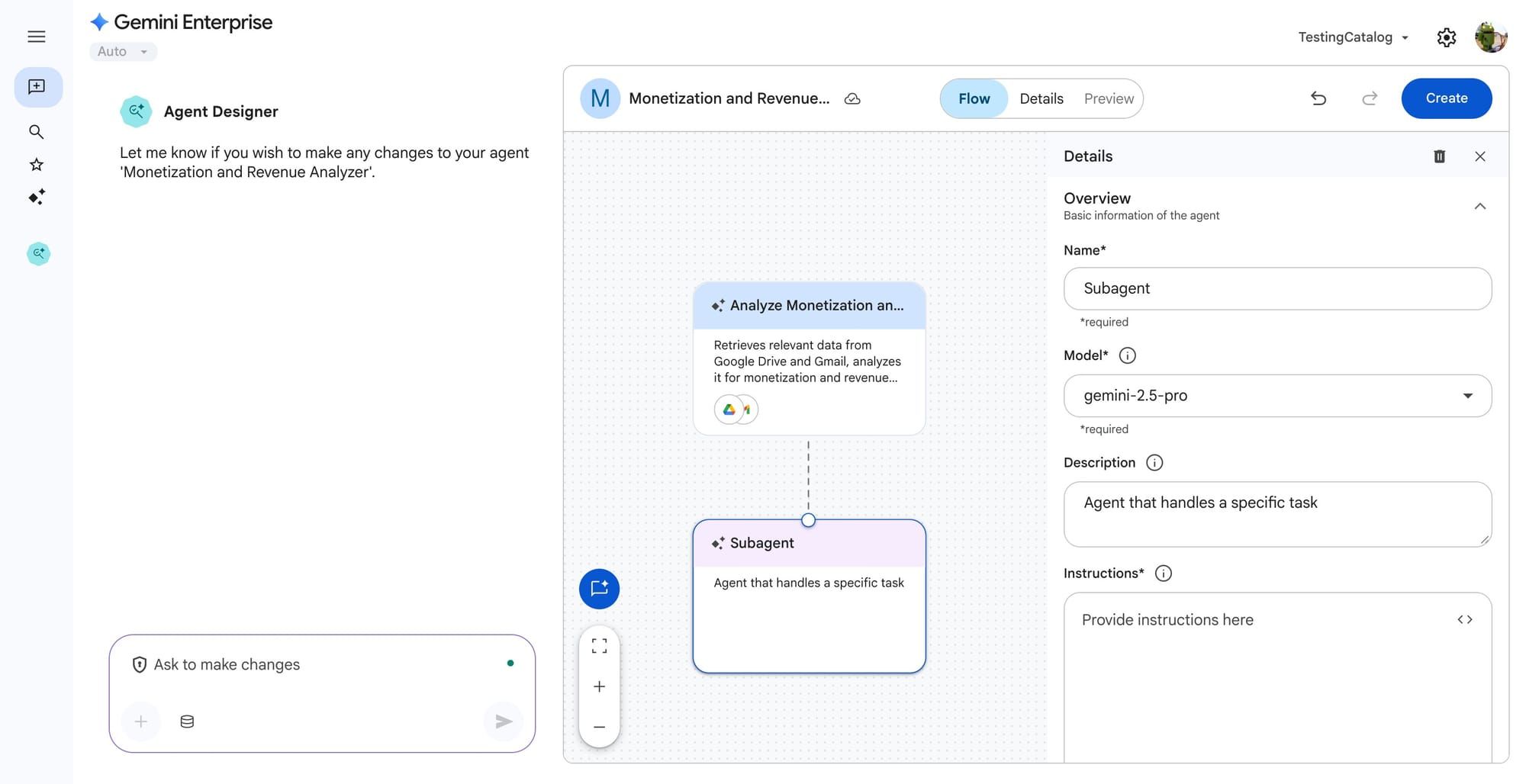
Describe the agent's purpose in plain language. Gemini generates the initial configuration - tools, knowledge, behaviour - which the user can then inspect, edit, or extend.
Path 02
Build from blank canvas
Start with an empty flow and build manually - adding nodes, tools, sub-agents, and logic step by step. For technical users who want full control from the first screen.
Path 03
View & modify the flow
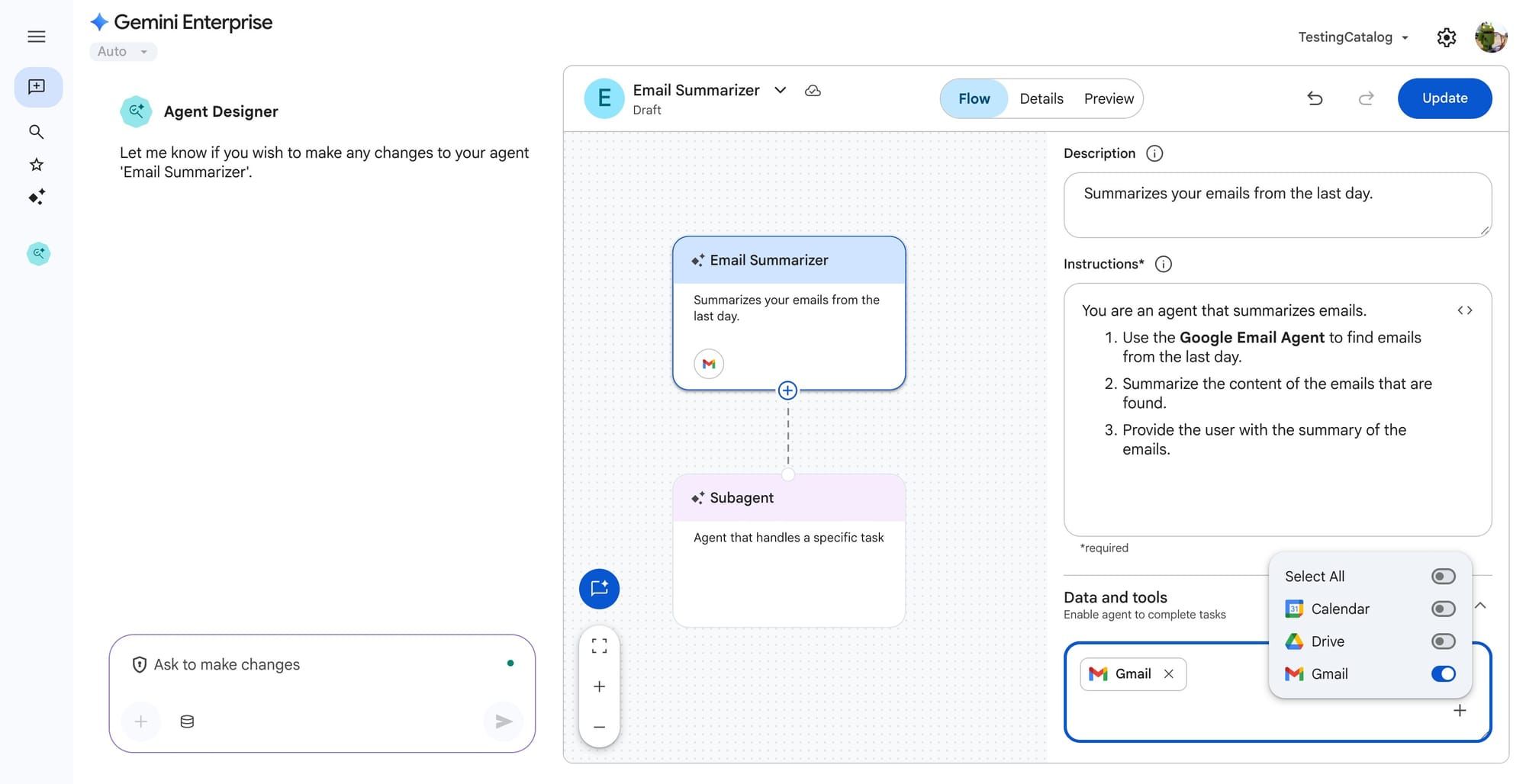
Full visibility into agent logic in a visual flow builder. Edit via natural language prompt or direct manual adjustment - adding tools, knowledge sources, and sub-agent nodes.
Path 04
Preview before publishing
Test the agent in an isolated preview environment before it reaches any real user - evaluating behaviour, edge cases, and response quality without risk.
The core design challenge was building two interfaces that felt like one product. The conversational builder generated structured agent configurations that the visual flow editor could immediately represent and make editable. Every node in the flow was an ADK-compliant artefact.
The unified design system
Input
Conversation or canvas
Business user describes intent or technical user builds manually
→
Gemini
ADK config generated
Structured agent configuration - tools, knowledge, sub-agents
→
Visual editor
Flow representation
Every node editable - readable by business users, controllable by developers
→
Preview
Test & validate
Isolated environment - verify behaviour before publishing to users
Milestone-driven design under pressure
With a public launch commitment and two major event deadlines, the design process had to be disciplined and milestone-driven. I structured the work into two clear launch targets - each build validated by real users.
M1 - Dogfood · Aug 2025
Internal validation
- Build agents conversationally
- Manual edit of agent details
- Preview before publishing
- Visual flow builder
- ADK compliant
M2 - GA · Oct 2025
Public launch
- All M1 features shipped
- Deterministic step support
- First-time guided walkthrough
- Visual flow builder
- Agent personalisation
Apr 2025
Cloud Next announcement
AgentSpace + no-code builder announced publicly. Design brief locked. 5-month clock starts.
May 2025
Google I/O announcement
Low-code builder announced. MVP re-direction - scope and target user model revised based on enterprise feedback.
Jun–Jul 2025
15+ design iterations
Conversational builder, flow editor, preview environment, and publish flow designed, tested, and refined across multiple rounds.
Aug 2025
M1 Dogfood
Internal launch with Googlers - usage data, feedback, rapid iteration before the public launch window.
Oct 2025
M2 GA Launch
Gemini Enterprise Agent Builder GA - on schedule, ADK-compliant, serving both business and developer users.
Results
Lasting impact
The Agent Builder became the centrepiece of Google's enterprise AI story in 2025. By designing an experience that met both business users and technical users on their own terms, the product shipped in October 2025 is now the foundation for how enterprises build, govern, and deploy AI agents on Google Cloud.
GA launch
Oct 2025
Shipped on schedule after 5 months - M1 dogfood in August, M2 GA in October
Design iterations
15+
Each validated against the core question: can a business user create a trustworthy agent without engineering support?
CUJ journeys
6
Critical user journeys shipped: create via conversation, build from canvas, view & modify flow, preview, publish, and first-time walkthrough
Announced at
2
Major Google events - Google I/O (low-code builder) and Cloud Next (AgentSpace + no-code builder)
Team led
4
UX designers (UXD + VisD), UX researcher, and content writer across the project
Complexity tamed
0→1
Form-based MVP evolved into a full human-AI orchestration platform serving business & technical users